

UK Bailiffs · Occupied vehicle removal

Van dweller and stealth camper removal

Rapid, documented support for unauthorised occupied vans, campervans and vehicle encampments on private and local-authority land across England and Wales.

It may look like an ordinary builder’s van. Inside, it may be someone’s permanent home.

Authority checked Before notice or attendance
Proportionate response Communication comes first
Private and council land Route selected case by case
Documented outcome Risk, attendance and report
Parking or occupation?

A developing property-management problem

Van dwelling generally means using a van or converted vehicle as a temporary or permanent home. Stealth camping is an informal expression commonly used where someone sleeps or resides in a vehicle while avoiding the outward appearance of camping.

Neither expression creates a separate legal status or an automatic right to remain on land. Equally, the appearance of a van does not prove that it is occupied unlawfully.

Most people living in vehicles cause no difficulty. The issue for a landowner or public authority arises where an occupied vehicle remains without consent, breaches a relevant restriction, obstructs access, creates safety or environmental concerns, or develops into a wider unauthorised vehicle encampment.

A parked van, a lived-in vehicle and an unauthorised encampment are not automatically the same legal case.
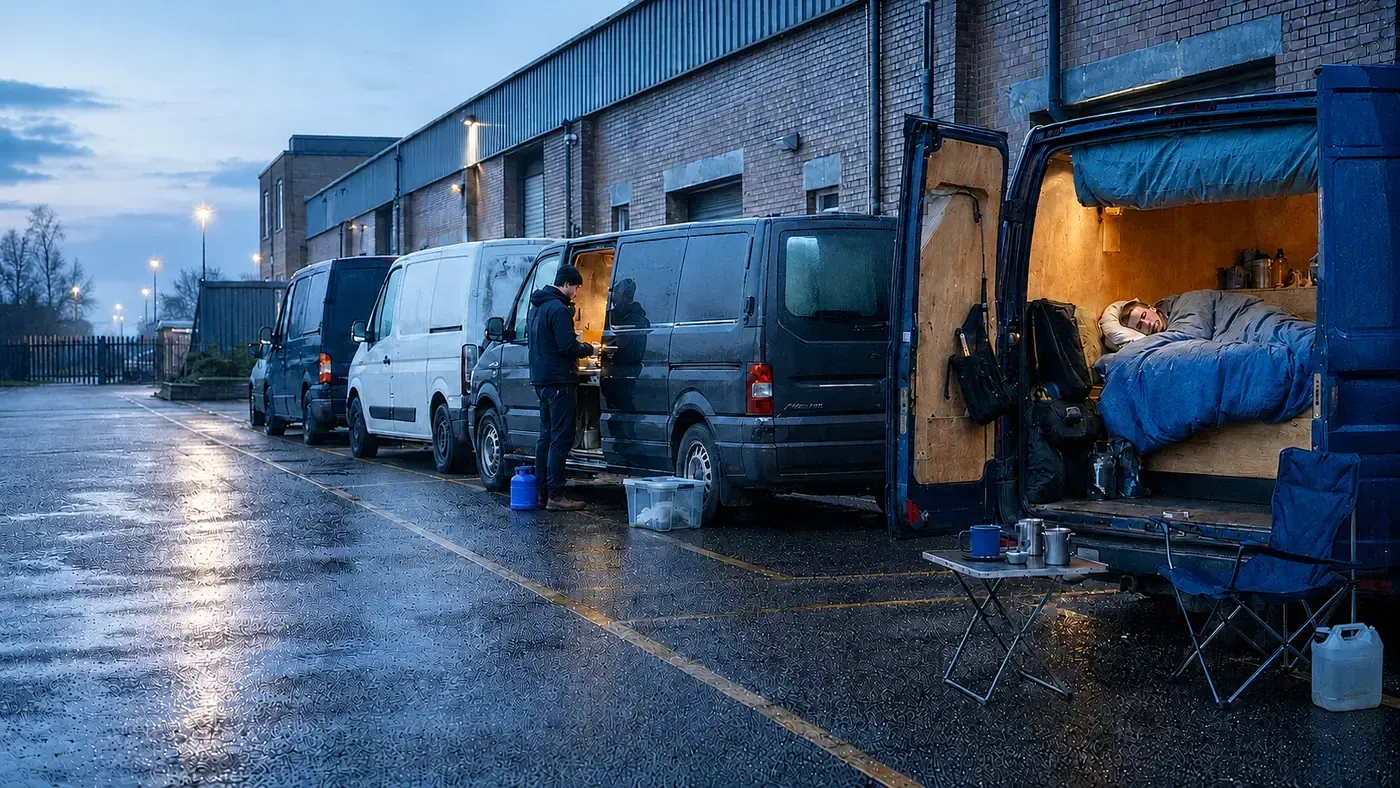
A row of occupied vans representing a van-dweller encampment
Occupied vehicles can range from a single overnight stay to an established group encampment.
Two distinct services

Support for private landowners and public bodies

The operational work may look similar, but the decision-making and legal responsibilities are different. We establish the correct instruction before deploying agents.

01

Private and commercial land

For PLCs, managing agents, retail parks, industrial estates, developers, farms, vacant sites and private car parks.

  • Ownership and authority review
  • Assessment of consent and occupation
  • Notice, engagement and negotiated departure
  • Common-law or court-route assessment
  • Attendance evidence and outcome report
02

Local authorities and public bodies

Operational support under the authority’s selected legal power, policy, delegated decision and public-law responsibilities.

  • Route-specific operational planning
  • Support with notice and document service
  • Welfare and vulnerability escalation
  • Multi-agency and police liaison where required
  • Auditable evidence and post-action reporting
Practical client guide

Download the Unauthorised Occupied Vehicles Guide

A practical eight-page guide for private landowners, PLCs, managing agents and local authorities dealing with van dwellers, stealth camping and other unauthorised occupied vehicles.

What the guide covers

A clear route from report to documented resolution

The guide explains the different considerations for private and local-authority land without suggesting that every occupied vehicle can be handled in the same way.

  • Private-land and local-authority options
  • Police powers and their limitations
  • Occupied-vehicle and towing safeguards
  • Information to send with an instruction
Download the 8-Page Guide

PDF · 8 pages · Version 1.0
Published September 2026

General information, not legal advice. Applies to England and Wales only. Each occupied-vehicle case must be assessed on its individual facts.

From report to recovery

A controlled four-stage process

The quickest sustainable outcome is often achieved through clear authority, early communication and a realistic departure arrangement.

Instruction review

We check the client’s authority, land, known history, vehicle status, access and intended outcome.

Site assessment

We record vehicles, apparent occupation, immediate hazards, vulnerability indicators and operational risk.

Notice and engagement

The position is explained clearly. Voluntary and controlled departure is prioritised wherever appropriate.

Attendance and report

Any authorised attendance is planned, evidenced and followed by a written outcome and recommended next steps.

Camouflaged van with deck chairs illustrating the informal expression stealth camping
A light-hearted image, but an important distinction: concealment does not determine the legal position.
What “stealth” really means

A description—not a legal category

Some occupied vans are obvious. Others retain commercial markings, covered windows or an ordinary panel-van exterior. Neither camouflage nor discretion creates permission to stay; equally, an unusual-looking van is not proof of trespass.

Our assessment is based on evidence: where the vehicle is positioned, who controls the land, whether consent exists, whether the person is residing there and what restrictions or legal powers apply.

That evidence-led distinction protects the client as well as the vehicle occupant.

Professional safeguards

Firm action with defensible decision-making

Welfare and vulnerability

Occupied vehicles may be homes. Children, disability, health needs, pregnancy, age and other vulnerabilities must be identified and escalated appropriately.

Public-body responsibilities

The authority retains its equality, human-rights, safeguarding, housing and public-law responsibilities. Our role is to support and implement its documented decision.

Evidence and accountability

Instructions, risk decisions, notices, photographs, attendance activity and outcomes are recorded for the client’s operational and governance file.

We do not prescribe one route for every occupied vehicle. We establish the facts and help the client implement the route it has lawfully selected.
External information

Legislation, official guidance and background reading

These independent sources explain the statutory framework and the language commonly used around vehicle dwelling. General-interest articles are included for background only and should not be treated as legal advice.

UK Bailiffs does not control third-party content. Inclusion of a link does not amount to endorsement of every statement on the linked page.

Frequently asked questions

Van dwellers and stealth campers

What is van dwelling?
Van dwelling generally means using a van, campervan or converted vehicle as temporary or permanent living accommodation. It is a description of how a vehicle is used, not a single legal status.
What is stealth camping?
Stealth camping is an informal expression for sleeping or residing in a vehicle while keeping the activity unobtrusive or disguising the vehicle’s residential use. Staying unnoticed does not itself create permission to occupy land.
Is stealth camping illegal in England and Wales?
There is no single offence called stealth camping. The position depends on consent, land ownership, parking restrictions, byelaws, highway rules, the way the vehicle is being used and whether other statutory conditions are present.
Can a landowner remove someone living in a van from private land?
Potentially, where the landowner is entitled to possession and the vehicle remains without consent. Common-law trespass action may be available, but disputed occupation, safety concerns or other complications can make court proceedings the appropriate route.
Is a court order always required?
No. Some private-land cases may be addressed through a properly managed common-law process, while local authorities have additional statutory options. A court order may nevertheless be necessary or preferable where facts, occupation or authority are disputed.
Can councils instruct private enforcement agents?
Yes, councils may procure operational and enforcement support. The council must retain responsibility for selecting and authorising the legal route and for satisfying its public-law, welfare, equality and safeguarding duties.
Can an occupied van simply be towed away?
No. Towing is not an automatic consequence of trespass. Removal or recovery of the vehicle must be supported by the specific legal authority being exercised and planned with regard to occupation, safety and property.
Will the police remove van dwellers?
Police have conditional powers under the Criminal Justice and Public Order Act 1994, including provisions amended or introduced by the Police, Crime, Sentencing and Courts Act 2022. Whether a threshold is met and a police power is exercised remain operational decisions for the police.
Secure online instruction

Authority to remove van dwellers or stealth campers

Provide the site, authority, vehicle and occupation details available to you. Photographs can be taken or uploaded through the form. Every instruction is reviewed before acceptance and deployment.

Van Dwelling and Stealth Camping Authority to Remove

For private landowners, managing agents, PLCs, councils and authorised professional clients.

Discuss an occupied-vehicle problem

Tell us where the vehicle is and what has happened

We will ask for the land address, ownership or management authority, vehicle numbers, known occupation, previous communication, photographs and any immediate welfare or safety concerns.