In some circumstances, a commercial landlord may recover possession of business premises by peaceable re-entry and change the locks without first obtaining a possession order. The right must arise under the lease, remain available and be exercised lawfully.
A commercial landlord may sometimes change the locks through peaceable re-entry
Where a commercial lease contains a valid right of re-entry or forfeiture, and that right has arisen and has not been waived, a landlord may in appropriate circumstances recover possession by peaceable re-entry.
This commonly involves attendance at apparently unoccupied commercial premises, gaining lawful peaceable access, replacing the locks, securing the property and displaying appropriate notices.
Peaceable re-entry is not suitable for every case. Particular care is required where somebody is present, residential occupation exists, the right to forfeit is uncertain, or insolvency restrictions may apply.
Before changing the locks
The landlord's right to forfeit must be checked first
Changing the locks is the operational step. The important question is whether the landlord has a presently exercisable right to recover possession.
01
Check the lease
The lease should contain an appropriate forfeiture or right-of-re-entry provision covering the relevant breach.
02
Confirm the breach
The landlord must identify the breach being relied upon, such as qualifying rent arrears or another covenant breach.
03
Check for waiver
Demanding or accepting rent, or other conduct recognising the continuing lease, can affect the right to forfeit for an existing breach.
04
Check occupation
Residential, mixed or disputed occupation can materially change the position and may make peaceable re-entry inappropriate.
Recover the premises
If the landlord wants the property back
Commercial lease forfeiture may be considered where unpaid rent or another qualifying breach has triggered a valid right of re-entry and recovering possession is the landlord's objective.
If the objective is to recover qualifying commercial rent while treating the lease as continuing, Commercial Rent Arrears Recovery may be the more appropriate route.
For most breaches other than non-payment of rent, section 146 of the Law of Property Act 1925 generally restricts forfeiture until an appropriate notice has been served and the statutory requirements have been met.
The notice must properly identify the breach and, where the breach is capable of remedy, require it to be remedied. An appropriate period must then be allowed before forfeiture is considered.
A properly planned commercial forfeiture involves considerably more than simply changing a lock.
1
Instruction and documents reviewed
The lease, arrears or breach information, authority, occupation and relevant risk factors are considered before attendance.
2
Attendance planned
Experienced enforcement agents and, where required, a locksmith attend at an appropriate time with the necessary site information.
3
Peaceable entry assessed on arrival
The circumstances at the premises are checked. If peaceable re-entry cannot lawfully or safely proceed, the attendance is not simply forced through.
4
Possession secured
Where possession is lawfully recovered, locks can be replaced and appropriate notices displayed.
5
Condition and goods documented
Photographs, meter readings, the condition of the premises and goods remaining inside are recorded for the client and subsequent management.
When not to proceed
Changing the locks may not be appropriate in every case
The lease does not provide a usable right of re-entry.
The alleged breach has not triggered the right.
The landlord may have waived the relevant breach.
Residential or mixed occupation is present.
Peaceable re-entry cannot take place because somebody is present.
Insolvency protection or a moratorium may restrict action.
The identity of the tenant or occupier is disputed.
A required Section 146 notice has not been properly dealt with.
Commercial landlord questions
Frequently asked questions
Does a commercial landlord always need a court order to change the locks?
No. Peaceable re-entry may be available in appropriate commercial lease cases without first obtaining a possession order. The contractual right to forfeit and the circumstances must nevertheless be checked carefully before action.
Can the locks be changed while the tenant is inside?
Peaceable re-entry should not involve forcing entry against a person present and opposed. Where occupation prevents lawful peaceable re-entry, another possession route may be required.
Can the landlord change the locks for unpaid commercial rent?
Potentially, where the lease gives a right of re-entry for rent arrears and that right has arisen and remains available. The landlord should decide whether the objective is possession through forfeiture or continued rent recovery through CRAR.
What happens to the tenant's goods after forfeiture?
Goods left behind should not simply be treated as the landlord's property. They should be identified and dealt with through an appropriate process, which may include notice and arrangements for collection or lawful disposal.
Can the tenant challenge the forfeiture afterwards?
A tenant or another qualifying party may in some circumstances seek relief from forfeiture. This is one reason why the landlord's entitlement and the evidence surrounding the re-entry should be properly documented.
Important:
This page provides general information about commercial lease forfeiture and peaceable re-entry in England and Wales. It is not legal advice and does not establish that a right to forfeit exists in any particular case. Where entitlement, waiver, insolvency, occupation, breach or notice validity is uncertain, appropriate legal advice should be obtained before action.
Commercial possession
Considering commercial lease forfeiture?
Send us the lease, rent or breach details and current occupation information. We can review the operational information required before attendance is arranged.
suggest adding an image of the brochure net to the download hero
…
Yes — I would add the brochure image beside the download copy. That will improve the section visually and make the PDF feel like a real resource rather than just another button.
I would not use the raw Duda image widget markup inside the HTML block. Instead, place the brochure image directly in the resource panel and make the layout two-column on desktop, stacked on mobile.
Replace the current downloadable landlord guide section with this:
Downloadable landlord guide
UK Bailiffs Section 146 Guide
Our downloadable Section 146 guide provides a practical overview for commercial landlords, managing agents and property professionals dealing with lease breaches.
It covers the purpose of a Section 146 notice, common breaches, service considerations and the relationship between Section 146 and commercial lease forfeiture.
Then replace the existing .ukb-s146-guide CSS with this:
I would also keep the image clickable to the PDF, as above. That is cleaner UX and reinforces the connection between the brochure cover and the downloadable guide.
The alt text is now meaningful too:
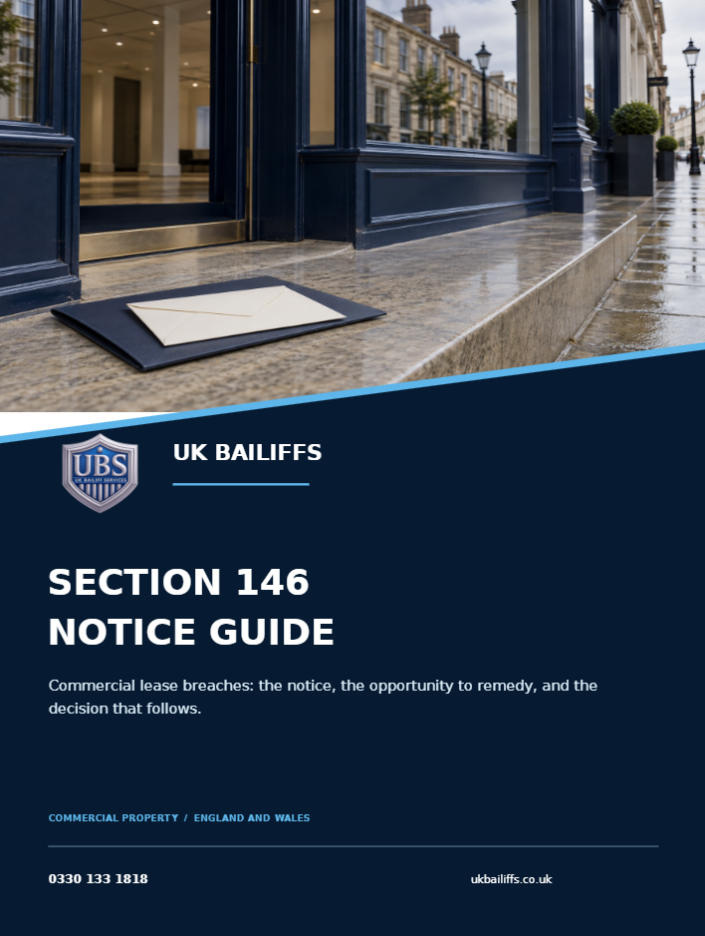
UK Bailiffs Section 146 Guide brochure cover
That is much better than leaving it blank.
full
Yes — here is the full /section-146 replacement page with the brochure image built into the downloadable guide section.
Commercial Lease Breach · England & Wales
Section 146 Notice for Commercial Lease Breaches
A Section 146 notice is generally required before a commercial landlord can enforce a right of re-entry or forfeiture for a breach of lease other than non-payment of rent. The notice must identify the breach, require remedy where the breach is capable of remedy and require monetary compensation.
A Section 146 notice is a formal notice served under section 146 of the Law of Property Act 1925 before a landlord enforces a right of re-entry or forfeiture for many breaches of a lease other than non-payment of rent.
The notice must specify the breach complained of. If the breach is capable of remedy, it must require the tenant to remedy it. It must also require the tenant to make compensation in money for the breach.
The landlord must then allow the tenant a reasonable time to comply before the right of re-entry or forfeiture is enforced.
Serving a Section 146 notice does not itself end the lease.
It is a statutory step that may be required before forfeiture can later be pursued.
Statutory requirements
What must a Section 146 notice contain?
The wording must reflect the actual lease, breach and remedy sought. A generic template should not be used without checking the facts.
01
Specify the breach
The notice must identify the particular breach relied upon clearly enough for the tenant to understand the allegation.
02
Require remedy where possible
If the breach is capable of remedy, the notice must require the tenant to remedy it.
03
Require compensation
Section 146 requires the notice to require the tenant to make compensation in money for the breach.
04
Allow reasonable time
The tenant must be given a reasonable opportunity to remedy the breach where it is capable of remedy and to make reasonable compensation.
Rent arrears and other breaches
Is a Section 146 notice required for unpaid commercial rent?
Non-payment of rent
Section 146 is generally not the rent-arrears notice
Section 146 does not generally require this notice before forfeiture for non-payment of rent.
Where rent arrears have triggered a contractual right of re-entry, the landlord may instead need to consider whether the objective is possession through forfeiture or rent recovery through CRAR.
For many breaches other than non-payment of rent, the landlord cannot enforce the right of re-entry or forfeiture until the statutory notice requirements have been satisfied.
The lease must still contain an applicable right of re-entry, and the breach relied upon must actually have occurred.
The lease wording and evidence must be checked in every case, but common examples include the following.
Unauthorised alterations
Structural or other works carried out without consent where the lease required landlord approval.
Disrepair
Failure to comply with repairing, reinstatement or maintenance obligations, subject to additional statutory protections in qualifying cases.
Unauthorised assignment or subletting
Assignment, sharing or occupation arrangements made contrary to the lease's alienation provisions.
Prohibited use
Use outside the permitted-use covenant, or activity expressly prohibited by the lease.
Nuisance or interference
Conduct affecting neighbouring occupiers, common areas or the wider property contrary to lease covenants.
Insurance or compliance breach
Conduct affecting insurance or breaching contractual safety, access or regulatory obligations.
From breach to service
What happens before a Section 146 notice is served?
1
Check the lease
Confirm the breached covenant, the forfeiture or re-entry clause and any contractual conditions affecting enforcement.
2
Establish the breach
Gather photographs, reports, correspondence, inspection material or other evidence supporting the allegation.
3
Check whether the right has been waived
Conduct recognising the lease as continuing after knowledge of the breach can affect the landlord's right to rely on that breach for forfeiture.
4
Prepare the notice
The notice should identify the breach precisely and reflect whether remedy is possible, the compensation requirement and the relevant evidence.
5
Serve and preserve evidence
The approved service method should be used and the date, time, location, recipient or delivery method and supporting evidence retained.
6
Allow reasonable time
The landlord should assess compliance and remedy after a reasonable period before deciding whether any later forfeiture step is available.
No universal deadline
How long does a Section 146 notice have to give the tenant?
Section 146 does not prescribe one fixed number of days that applies to every commercial lease breach.
Where the breach is capable of remedy, the tenant must be allowed a reasonable time to remedy it. What is reasonable depends on the nature of the breach, the work or action required, the circumstances of the premises and the surrounding facts.
Important:
a notice should not simply insert a standard deadline without considering what the breach would realistically require the tenant to do.
Legal and practical safeguards
Issues that can change the Section 146 route
Service of a notice does not cure a defective right to forfeit. These matters should be considered before the notice is relied upon.
Waiver of the right to forfeit.
Disputed breach or disputed lease wording.
Repair breaches and the Leasehold Property (Repairs) Act 1938.
Administration, liquidation or another insolvency process.
Residential or mixed-use occupation.
Whether the breach is capable of remedy.
Whether the proposed time for remedy is reasonable.
Potential relief from forfeiture.
UK Bailiffs Section 146 service
Preparation, professional service and evidence
UK Bailiffs can support Section 146 instructions from the documents and scope supplied by the client, or serve a notice prepared and approved by the client's solicitor.
Our service can include reviewing the supplied lease and breach information for operational completeness, planning service, agent attendance, appropriate evidence of delivery and a service report.
Where the underlying breach, drafting, waiver position or right to forfeit is disputed or legally complex, the notice should be approved by the client's solicitor before service.
Downloadable landlord guide
UK Bailiffs Section 146 Guide
Our downloadable Section 146 guide provides a practical overview for commercial landlords, managing agents and property professionals dealing with lease breaches.
It covers the purpose of a Section 146 notice, common commercial lease breaches, service considerations and the relationship between Section 146 and commercial lease forfeiture.
A Section 146 notice is a formal notice under the Law of Property Act 1925 that is generally required before a landlord enforces a right of re-entry or forfeiture for many lease breaches other than non-payment of rent.
When is a Section 146 notice required?
It is generally required where a landlord intends to enforce a right of re-entry or forfeiture for a qualifying breach of covenant other than non-payment of rent. The lease must contain an applicable right of re-entry and the breach relied upon must have occurred.
What must a Section 146 notice contain?
The notice must specify the breach, require the tenant to remedy it where the breach is capable of remedy, and require compensation in money for the breach.
Is a Section 146 notice required for commercial rent arrears?
Generally no. Section 146 does not usually require this notice before forfeiture for non-payment of rent. Rent arrears may instead raise separate questions about lease forfeiture, CRAR and waiver.
How long must a Section 146 notice give the tenant?
There is no universal number of days for every breach. The tenant must be allowed a reasonable time to remedy the breach where it is capable of remedy. What is reasonable depends on the breach and surrounding circumstances.
Does a Section 146 notice terminate the lease?
No. Serving the notice does not itself terminate the lease. It is a statutory preliminary step before forfeiture may later be considered in a qualifying case.
Can a Section 146 notice be used for disrepair?
Potentially, but repair covenant breaches can be subject to additional statutory protections under the Leasehold Property (Repairs) Act 1938. Qualifying cases require particular care and legal advice.
What happens if the tenant remedies the breach?
The effect depends on the breach, the lease and the circumstances. Where the breach is capable of remedy, Section 146 requires the tenant to be given the opportunity to remedy it before the landlord enforces the right of re-entry.
Can the tenant apply for relief from forfeiture?
Yes. A tenant and certain other interested parties may in appropriate circumstances apply to the court for relief from forfeiture. Proper service of a Section 146 notice does not prevent such an application.
Who can serve a Section 146 notice?
The notice is served on behalf of the person entitled to the reversion and the relevant right of re-entry. A professional process server or enforcement agent can carry out service, but the authority, recipients and permitted service method should be checked first.
Can UK Bailiffs prepare and serve a Section 146 notice?
UK Bailiffs can support preparation from the client's approved instructions and arrange professional service with evidence. Where the legal basis, drafting or right to forfeit is disputed or complex, solicitor approval should be obtained before service.
Important:
This page provides general information about Section 146 notices and commercial lease breaches in England and Wales. It is not legal advice and does not establish that a right to forfeit exists in a particular case. Where the breach, lease wording, waiver, remedy, insolvency position or notice validity is uncertain, appropriate legal advice should be obtained before enforcement action is taken.
Commercial lease breach
Need a Section 146 notice prepared or served?
Send us the lease, breached covenant, forfeiture clause, supporting evidence and authority to act. We can identify the operational information required for preparation or professional service and provide clear evidence of attendance.
This is the version I’d use. The brochure now feels like a proper resource asset rather than an afterthought, and the image itself is clickable to the PDF.
User attachment
That looks good.
The important parts in your screenshot are:
Indexed successfully — Bing can show the URL.
No SEO/GEO issues found — Bing is not flagging a basic technical problem with the page.
OpenGraph detected — social/meta markup is being recognised.
The only thing I’d do now is click Request indexing because you’ve just materially rebuilt the page. That gives Bing a direct signal that the content has changed.
The lack of additional markup types is not a problem by itself. I would not start adding schema simply because Bing only shows OpenGraph here. For this Section 146 page, the bigger gains are likely to come from the stronger copy, direct-answer structure, authoritative legislation links, brochure asset, and internal links to forfeiture/relief/CRAR.
So at this point:
Request indexing → leave the page alone → let Bing recrawl it.
Then we should watch whether the AI citation share improves for the Section 146 query set rather than immediately making more changes.
Pasted text(20260927-152550).txt
Document
now the additional pages need to be added to the head - without changing anything else
Yes. I’ve checked the header code you uploaded. The Property & Possession section already contains /forfeiture, /relief-from-forfeiture-a-guide and /section-146, so I would add only the two genuinely additional pages we have created/rebuilt today:
/can-a-commercial-landlord-change-the-locks
/landlord-and-tenant-solutions/should-i-use-crar-or-forfeiture
That keeps the navigation clean and avoids changing anything else. Your existing Property & Possession links are at this part of the header.
Replace only this existing block:
Nothing else in the header needs changing.
I’ve deliberately positioned the two additions directly beneath Commercial Lease Forfeiture, because they form one coherent commercial-landlord cluster:
Commercial Lease Forfeiture
→ Can a Commercial Landlord Change the Locks?
→ CRAR vs Lease Forfeiture
→ Relief from Forfeiture
→ Section 146
That is also the logical order for Bing/Copilot and internal-link context.
full
Yes — I’ve produced the full header code with only those two additional Property & Possession links added. Everything else is unchanged from the header you supplied. The original Property & Possession block is the one around the existing forfeiture, relief and Section 146 links.
The only additions are: